
Decision-Making Under Pressure Assessment
Our decision-making under pressure assessment is designed to reveal one of the most important aspects of work: how individuals and teams make choices when the pressure is on due to time constraints or looming high-stakes consequences. The goal is to determine if decision makers remain calm and analytical under pressure or if they tend to break down and revert to impulsive actions, poor communications and poor judgment.

How the Decision-Making Under Pressure Assessment Works
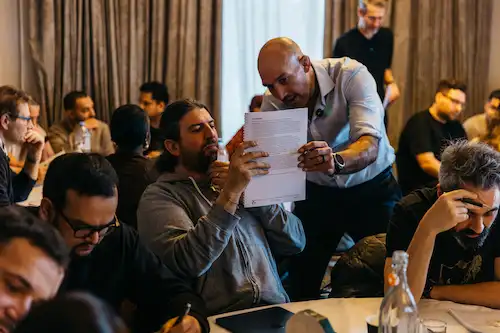
This kind of assessment focuses on cognitive and behavioural responses to stress and pressure. Participants are presented with a series of realistic scenarios that accurately simulate high-pressure work situations, including crisis management, competing priorities and looming deadlines.
These scenarios may be delivered by way of questionnaires, role-playing exercises, simulations or digital testing platforms. Responses are then compared to key performance indicators typically linked to sound decision-making processes.
Areas commonly evaluated by this assessment include
• The ability to prioritise information quickly and accurately
• Risk awareness and judgement quality
• Stress tolerance and emotional regulation
• Speed vs accuracy in decision making, and whether it changes when stress is introduced
• The quality of communication and collaboration under pressure
The decision-making under pressure assessment typically follows three stages:
Stage 1: Simulation or testing: Participants complete a series of pressure-based decision tasks
Stage 2: Analysis: Responses are evaluated using psychological benchmarks
Stage 3: Development planning: Training strategies, including targeted coaching, are then recommended
Key benefits for organisations include
• Reduced risk of costly errors in high-stress situations
• Enhanced leadership when it comes to readiness and resilience
• Better coordination during high-stress events
•The ability for managers to make better selections when it comes to promotion decisions

Trish Harrison

The great strength of C-me is its accuracy and its simplicity to use.

Samantha Westbrook

C-me has coloured our working world and improved our working relationships.

Gemma Simmonds

Participants on the course state that they are more measured in their responses and have a greater understanding of peoples behaviour.
Colin Priestley – Wal

C-me is an enabler to support everyone at LMG to be more aware, involve the right people and to create a solution approach.

Anthony Jones

C-me has helped enable our teams in understanding and appreciating difference.

Kiranjit Kulla

C-me has been a critical tool to enhance our new performance review process.

Jo Ivers
L&D Lead

C-me has allowed teams to have conversations about communication and behaviour in a clear, consistent and non-confrontational way.

Sian Davies–Hamilton
It helped us appreciate each other’s communication preferences better, and understand and avoid previous areas of misunderstanding.










About C-me
The C-me decision-making under pressure assessment, and the rest of the C-me assessment suite, was developed by a group of assessment industry professionals who had grown disillusioned with standard assessment tools of the day (many of which are still in use, unfortunately). After several years of work, they emerged with the C-me assessment suite. This suite of tools has proven so effective that it has been widely adopted by countless SMEs as well as industry giants like Oracle, Virgin Active, HSBC, the NHS and the BBC.
250 000+
reports completed
13 000+
team diagnostics or profiles completed
2 500+
organisations using C-me